
Spray Foam for Multi-Family Attics in Addison, TX
Why Multi-Family Attics in Addison Need Spray Foam
Your Addison multi-family attic is probably wasting energy right now. I've seen it in countless attics across this town. Addison homes average 96°F in the summer, and that heat pours into your attic. Most attics here were built before 2000 and have old fiberglass insulation that's settled and lost its R-value.
Fiberglass works when it's fluffy and full of air pockets. After years in a Texas attic, it compresses, collects dust, and stops doing its job. Your AC runs longer. Your energy bills go up. Multi-family homes in Addison Circle or Vitruvian Park share common walls, which means heat moves between units easier. One neighbor's AC fighting the heat makes the whole building work harder.
Spray foam is different. It creates an air barrier. Closed-cell spray foam seals every crack and gap. No air moves through it. The U.S. Department of Energy says air sealing is the most cost-effective way to save energy. Spray foam does both jobs at once.
I'm not going to tell you spray foam is right for every attic. It's not. But for multi-family homes in Addison's hot-humid climate, it solves the two biggest problems: air leakage and thermal bridging through shared walls. If you've got a utility bill you can't explain, your attic insulation is probably the reason.
Addison's Climate and Your Multi-Family Attic
Addison sits in IECC Climate Zone 3, which means hot summers and mild winters. Our cooling degree days hit around 3,000 per year. That's a lot of hours your AC has to run. In a multi-family building, every unit pulls from the same conditioned air. A leaky attic forces your system to pull in 140-degree attic air to cool your home.
Your electric rate in Addison is around $0.158/kWh. In a deregulated market like ours, you can shop for better plans, but no plan fixes a leaky attic. The cheapest electricity still costs too much if your insulation is failing.
Spray foam handles moisture better in this climate too. Addison's humidity can trap moisture in fiberglass, leading to mold and rot in your attic structure. The Environmental Protection Agency warns that mold in attics can affect indoor air quality for everyone in the building. Closed-cell spray foam acts as a vapor barrier. It doesn't absorb moisture like fiberglass or cellulose.
Your neighborhood matters too. Homes in Prestonwood tend to have larger attics with more ductwork. More ductwork means more potential leaks. Spray foam encases your ducts in a conditioned space. Your AC doesn't lose cool air to a hot attic. It stays in your living space where it belongs.
The Multi-Family Insulation Problem in Addison
Multi-family homes have challenges single-family houses don't. Shared attics mean one neighbor's problem becomes everyone's problem. If the insulation is bad in one section, heat migrates through the whole attic cavity. You can't just fix your unit and ignore the rest.
Most Addison multi-family homes were built with fiberglass batts. Those batts were installed between ceiling joists. But builders often left gaps around pipes, wires, and ductwork. Those gaps are direct paths for heat and cold air. Spray foam fills those gaps completely. It conforms to every irregular shape in your attic.
Another issue: fire safety. Multi-family buildings need to meet stricter fire codes. Spray foam comes in different formulations for different applications. Closed-cell spray foam has better fire resistance than open-cell. It also adds structural rigidity to your roof deck. In a town with tight lots like Addison's—typically a quarter acre or less—neighbors are close. Proper fire-rated assemblies matter.
If you've got an older multi-family home near Addison Airport, you might have noise concerns too. Spray foam dampens sound transmission between units. It's not the same as acoustic insulation, but it reduces airborne noise from the attic. That's a bonus you don't get from fiberglass.
What to Expect with Spray Foam Installation
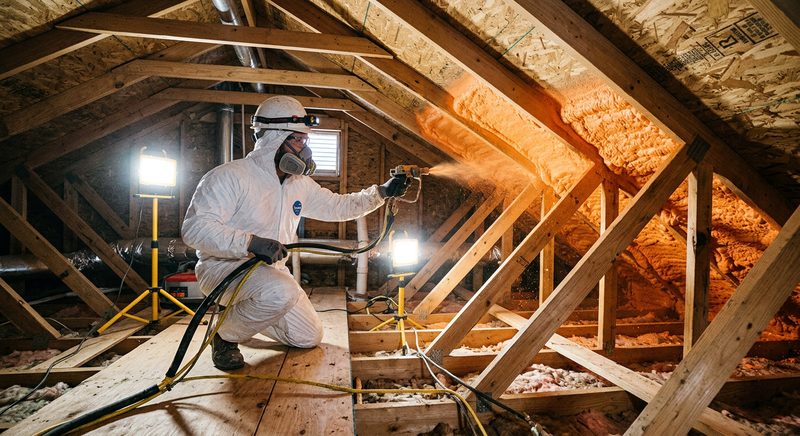
Spray foam installs differently than other insulation. It's a two-part chemical that mixes at the spray nozzle. The crew suits up in protective gear. They spray a liquid foam that expands 30 to 60 times its volume in seconds. It hardens into a rigid, closed-cell foam that sticks to everything.
The job usually takes a day for a typical Addison multi-family attic. Your crew needs access to the attic. That's usually a pull-down ladder in a garage or hallway ceiling. Clear anything stored near the access point. The crew will move through the attic systematically.
You need to be out of the unit during installation. The chemicals have an odor during curing. It's not dangerous once cured, but the smell is strong. Most people leave for 4 to 6 hours while the foam cures. After that, you're good to return.
The finished foam looks like a hard plastic coating. It ranges from light yellow to amber. It's smooth to the touch and completely sealed. No air gaps. No settling over time. It should last the life of your building if installed correctly.
We handle the whole process. Free estimate, site prep, installation, and cleanup. I've been in attics across DFW for years. I know what works for Addison's multi-family homes.
Spray Foam vs. Other Addison Insulation Options
Addison homeowners have options. Fiberglass, cellulose, radiant barriers, and spray foam all work differently. For multi-family attics, spray foam wins on air sealing and long-term performance.
Fiberglass batts are cheap upfront. But they settle, get dirty, and lose R-value. Batts leave gaps around framing. Air moves through those gaps. Your conditioned air leaks into the attic. Fiberglass also soaks up moisture in Addison's humid climate. Wet insulation is worthless.
Blown-in cellulose is better than fiberglass. It fills gaps and voids. But it's heavy. Over time, it settles and compresses. It also absorbs moisture. In a leaky attic, cellulose can hold water and cause rot. Cellulose needs a vapor barrier under it.
Radiant barriers reflect heat away from the attic. They help in summer but don't insulate. You still need bulk insulation underneath. Radiant barriers alone won't solve your Austin energy bills.
Spray foam does everything. Air seals. Insulates. Acts as a vapor barrier. Adds structural strength. It's more expensive upfront, but it lasts decades without maintaining. The ENERGY STAR program recommends air sealing as the first step. Spray foam does it in one step.
Competitors like Apex Insulation Solutions and American Insulation serve Addison too. They're good companies. But most of them treat insulation as material installation, not problem-solving. We look at your attic, find the specific issues, and fix them right the first time.
Getting Your Free Estimate for Addison Multi-Family Spray Foam
You don't need a sales pitch. You need a straight answer about what your attic needs. That's what we do. I come out, look at your attic, check the existing insulation, the ventilation, the air sealing, and the ductwork. Then I tell you what will work best.
Every Addison multi-family attic is different. A 1990s townhouse in Addison Circle has different issues than a newer build in Vitruvian Park. Home styles here range from Ranch to Contemporary. Construction materials vary: brick, drywall, wood framing. Each one needs a custom approach.
We don't pressure you. You get the estimate. You decide. If spray foam is right, we schedule the install. If fiberglass or cellulose would work better for your budget, I'll tell you that too. There's no one-size-fits-all solution.
Call us at (469) 895-2695. We'll set up a time to check your attic. We work around your schedule. You'll get honest advice and a fair price. That's it. We're a local crew with years of combined experience. You can trust us to do the job right because we live and work in the same Dallas-Fort Worth heat you do. We know what works here because we've seen it work.
** ** ** ** **
Is spray foam safe for multi-family homes in Addison?
How long does spray foam last in an Addison attic?
Will spray foam save me money on my Addison electric bill?
Can I install spray foam in only part of my multi-family attic?
What's the difference between open-cell and closed-cell spray foam?
Get a free estimate for spray foam in Addison
Fill out the form and we'll get back to you within 24 hours. No pressure, no upsells.
Also serving: Attic insulation service details · Attic insulation cost guide · Contact us
Nearby cities: Addison · DeSoto · DeSoto · DeSoto · Farmers Branch · All DFW locations
Last updated: 2026-05-29