
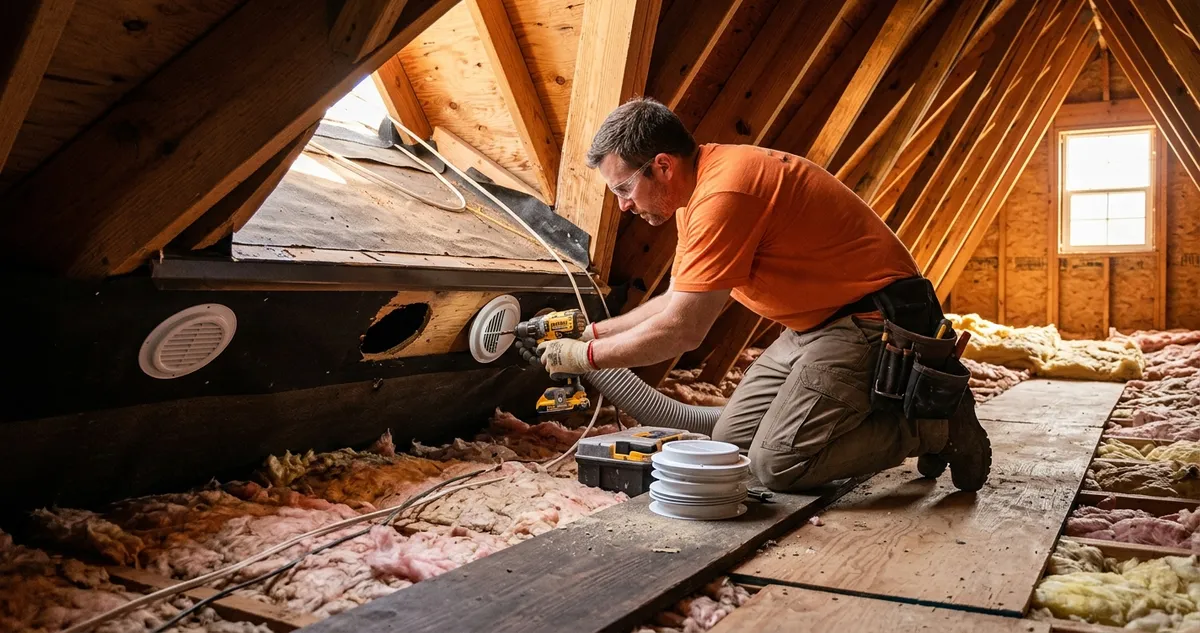
DFW Attic Insulation: Adding Soffit Vents for Cooler Homes
Learn how adding soffit vents cools your DFW attic and lowers AC bills. Expert tips on calculating vents, installing baffles, and avoiding common mistakes.
Why Attic Ventilation Matters in Dallas-Fort Worth
Your attic needs airflow to keep your home cool. In the Dallas-Fort Worth metroplex, summer temperatures regularly push past one hundred degrees. Without proper airflow, your attic turns into a giant brick oven. That trapped heat radiates down through your ceiling drywall and forces your air conditioner to run constantly.
Adding attic vents is the best way to stop this heat buildup. A balanced attic uses both intake and exhaust vents. Cool air must enter at the bottom of the roof so hot air can escape through the top. If you only have exhaust vents at the ridge, your attic cannot breathe.
I have crawled through attics across the metroplex for years. Many homeowners install a new roof but forget about the intake air. Without intake vents, your ridge vents cannot do their job properly. This imbalance ruins your home comfort and spikes your electric bills.
Proper ventilation also protects your roof decking from rot. During our humid Texas winters, moisture from your bathrooms and kitchen climbs into the attic. If that moisture cannot escape, it condenses on the cold wood. This causes mold and wood rot over time. Adding soffit vents solves both the summer heat and winter moisture problems. The U.S. Department of Energy recommends balanced attic ventilation for every home (energy.gov/energysaver/insulation).
What Are Soffit Vents and How Do They Work?
Soffit vents are intake vents installed under the eaves of your roof. They sit in the overhang that sticks out past your exterior walls. When wind blows against your house, these vents draw cool outdoor air into the attic space. This cool air pushes the hot, stagnant air up and out of your roof vents.
Installing soffit vents creates continuous natural airflow. This process uses no electricity — it relies on hot air rising naturally. As long as your soffit vents remain clear, your attic stays significantly cooler.
There are two main styles of these vents. Individual rectangular vents are spaced out along the eaves. Continuous strip vents run the entire length of the soffit. Both styles work well if they are installed correctly and kept clear of debris.
Many older homes in areas like Dallas were built without these vents. Builders back then relied on simple gable vents on the sides of the house. Today, we know that adding soffit vents to old house structures is much more effective. It brings cool air in at the lowest roof point.
How to Tell If Your Attic Needs More Soffit Vents
Check if your attic has enough intake air. The simplest method is a visual inspection from your yard. Walk around your home and look up under the eaves. If you see solid wood or vinyl with no grates, you lack intake ventilation.
If you do see vents, they might be blocked. Painters often spray over vent screens. This dried paint seals the holes and stops all airflow. Dust, spiderwebs, and old insulation can also clog these small openings over the years.
You can perform a simple test with a single sheet of tissue paper. Go into your attic on a warm day. Hold the tissue paper near the soffit openings. If the paper does not flutter or move toward the attic, air is not flowing. This means you need to look into installing soffit vents in attic spaces to restore the draft.
Another sign of poor ventilation is a hot ceiling. Walk your hallway in July and touch the ceiling drywall. If it feels hot to the touch, your attic is trapping heat. This is a clear sign that you need to improve your attic insulation and add more intake vents.
Step-by-Step Guide: How to Install Soffit Vents
Installing attic soffit vents is a project you can tackle yourself. You will need a drill, a jigsaw, safety glasses, and a sturdy ladder. Always work with a partner when you are up on a ladder. Start by marking the locations for your new vents between the rafter tails.
Next, drill starter holes in the corners of your marked rectangles. Use your jigsaw to cut out the wood panels carefully. Watch out for hidden nails or electrical wires behind the soffit board. Once the hole is open, clear away any loose debris from the opening.
Now you can place the vent cover over the hole. Screw it securely into the soffit wood using outdoor-rated screws. Make sure the louvers on the vent point toward your house. This prevents wind-driven rain from blowing directly into your attic.
If you are working on an older home in Fort Worth, you might have solid wood soffits. Adding soffit vents to old house eaves takes a bit more muscle. The wood is often thick, old-growth pine that is tough to cut. Take your time and use a sharp wood blade on your saw.
The Math: How Many Soffit Vents Do You Actually Need?
Do not guess when adding attic vents. There is a specific formula used to find the right amount of ventilation. The building code requires one square foot of vent area for every three hundred square feet of attic floor (energy.gov/energysaver/types-insulation). If you do not have a vapor barrier, you need one square foot for every one hundred and fifty square feet.
Calculating soffit vents starts with measuring your attic floor space. Multiply the length of your attic by the width to get the total square footage. For a fifteen hundred square foot attic, you need ten square feet of total vent area. This total area must be split equally between intake and exhaust vents.
That means you need five square feet of intake vents and five square feet of exhaust vents. Vent manufacturers print the Net Free Ventilating Area, or NFVA, on their packaging. This number tells you how much actual open space the vent provides. You can use this rating to buy the exact number of vent covers you need.
Keep your intake and exhaust balanced to avoid pressure issues. If you have too much exhaust and not enough intake, the system pulls air from your living space. This sucks your expensive air-conditioned air right up into the attic.
Common Mistakes to Avoid
The most common mistake I see is blocking the intake vents with insulation. When insulation crews blow loose fiberglass or cellulose into an attic, it often slides down into the eaves. This completely blocks the soffit vents and stops the airflow. Your new vents will not do any good if they are buried under a foot of pink fiberglass.
Prevent this by installing baffles before insulating. Baffles are plastic or cardboard channels that staple directly to your roof rafters. They create a clear path for air to flow from the soffit vent up over the insulation pile. This keeps your insulation in place and keeps your air path wide open.
Another mistake is mixing different types of exhaust vents. Do not use turbine vents, ridge vents, and gable vents all at the same time. The air will just short-circuit between the exhaust vents instead of pulling cool air from the soffits. Stick to one style of exhaust and pair it with plenty of soffit intake.
Finally, do not skip the air sealing step before you insulate. Air leaks around your light fixtures and plumbing pipes let conditioned air escape. Proper attic insulation works best when your ceiling is sealed tight. Ventilation only works when the air comes from the outside, not from your living room.
When to Hire a Professional vs. Doing It Yourself
Installing soffit vents is a manageable project for a handy homeowner. It requires basic tools and some patience on a ladder. However, working in an attic is hot, dusty, and physically demanding. If your roof has a low pitch, reaching the eaves from the inside can be nearly impossible.
You have to crawl into the tightest corners of the attic where the roof meets the floor. One wrong step can send your foot straight through your living room ceiling drywall. You also have to deal with extreme heat, nails sticking through the roof deck, and old insulation dust.
If you are uncomfortable with heights or tight spaces, call a professional. A local crew has the right tools to cut vents quickly and safely. They can also install baffles and blow in new insulation at the same time. This ensures your attic system works together to lower utility bills.
I have fixed many DIY ventilation jobs that went wrong. It is always cheaper to get it done right the first time. If you want an honest assessment, I can inspect your vents and find the best way to cool your home.
How many soffit vents do I need for my DFW home?
Can I install soffit vents from the outside?
Do soffit vents work without a ridge vent?
How do I know if my soffit vents are blocked?
P.S. Every attic is different. The numbers above are ballpark estimates based on DFW averages. Call us at (469) 895-2695 and we'll come take a look with a thermal camera, give you a written quote, and tell you honestly if you even need anything. No upsell. No pressure.
Get a free estimate
Fill out the form and we'll get back to you within 24 hours. No pressure, no upsells.
Neal runs DFW Attic Insulation, a local crew serving the entire Dallas-Fort Worth metroplex. He started in roofing and construction over two decades ago and now specializes in attic insulation, air sealing, and ventilation. He believes in honest advice — he'll tell you if you don't need anything.